
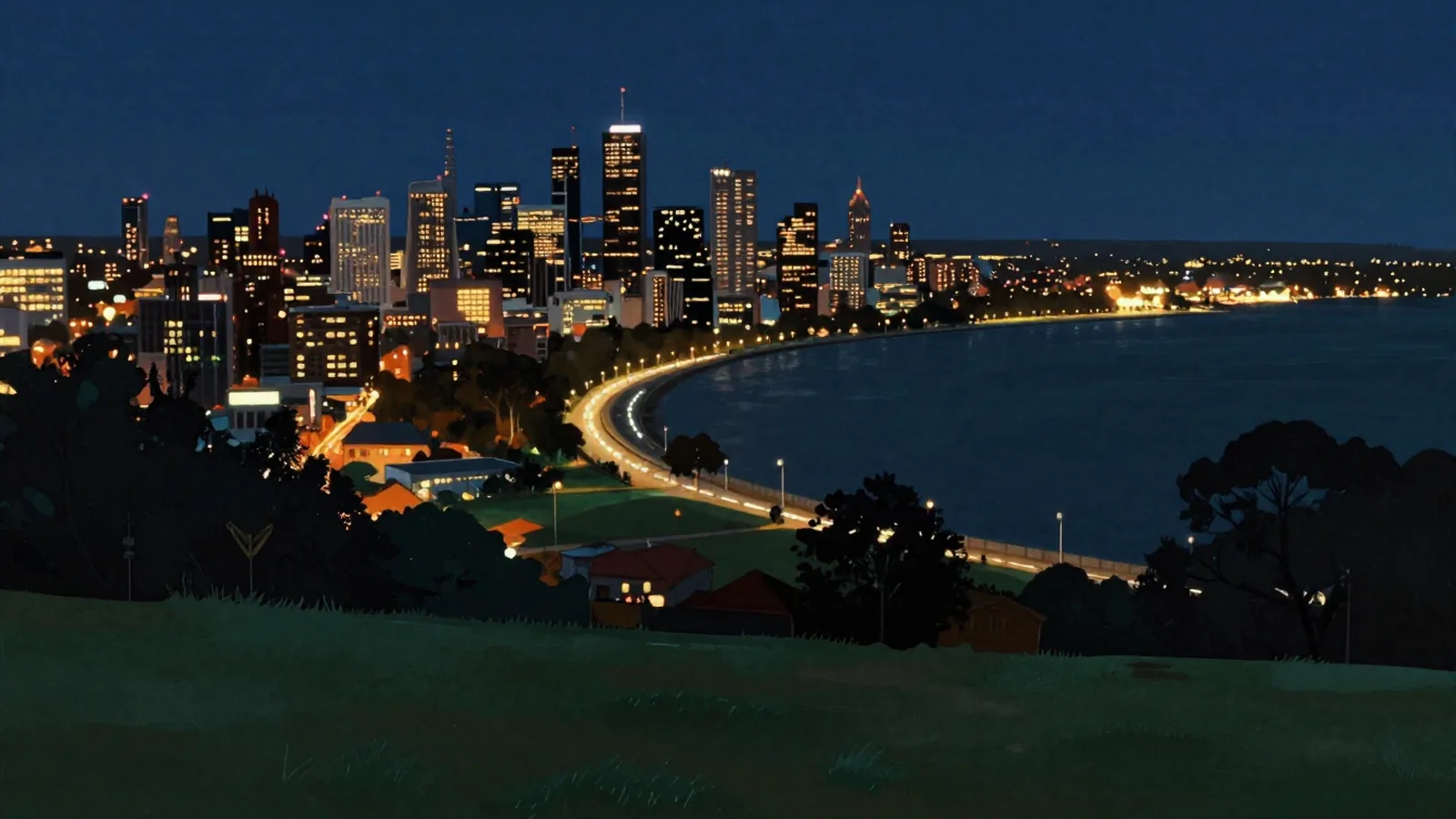

Which Is the Loneliest Big City on Earth?
Perth is famous as the loneliest big city on Earth. Count another way and it is Auckland, or Honolulu: it depends on what counts as a city, and as big.
Perth is famous as the loneliest big city on Earth [1][2]. We measured every big city on the planet, and yes, it's Perth [3]. Unless it's Auckland. Or Honolulu [3][4]. The answer depends on two choices that rankings rarely spell out: what you call a city, and how big counts as big [2][5]. Here is how each choice moves the crown.
Why is Perth called the loneliest big city?
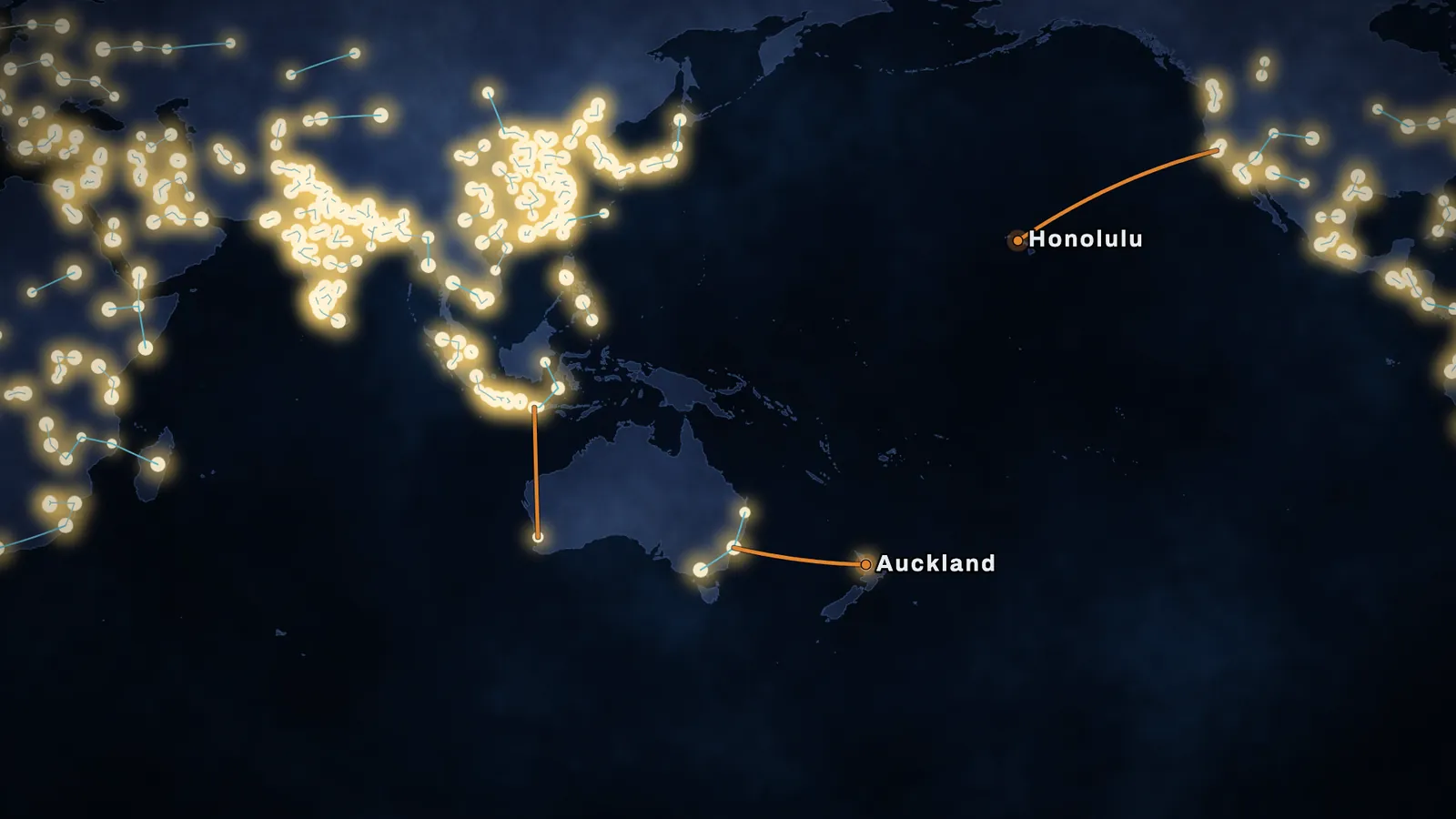
Perth sits on the Indian Ocean coast of Western Australia, with most of a continent at its back [1][6]. Britannica calls it one of "the most isolated of the world's administrative centres" [1]. By our calculation it is closer to Jakarta, 2,993 km away, than to Sydney, 3,279 km away [3]. Its nearest big Australian neighbour, Adelaide, is more than 2,000 km away, about the distance from Amsterdam to Moscow [3][7].
The British founded Perth in 1829, as the Swan River Colony, on the land of the Whadjuk people of the Noongar nation; in Noongar the river is the Derbarl Yerrigan [6][8][9]. A gold rush in the 1890s brought people and money, while the rest of Australia was a rough sea voyage away [6][10]. Distance helped make Western Australia "a late and somewhat reluctant member" of Australia [11]. It joined on the promise of a railway east, which was completed across the Nullarbor Plain on 17 October 1917 [10][12]. On 8 April 1933 about two-thirds of its voters chose to leave Australia; in May 1935 the British Parliament refused their petition [13][14]. In June 2025 Greater Perth, the official metro area, had 2,452,765 people: four in five Western Australians [15].
What counts as a city?
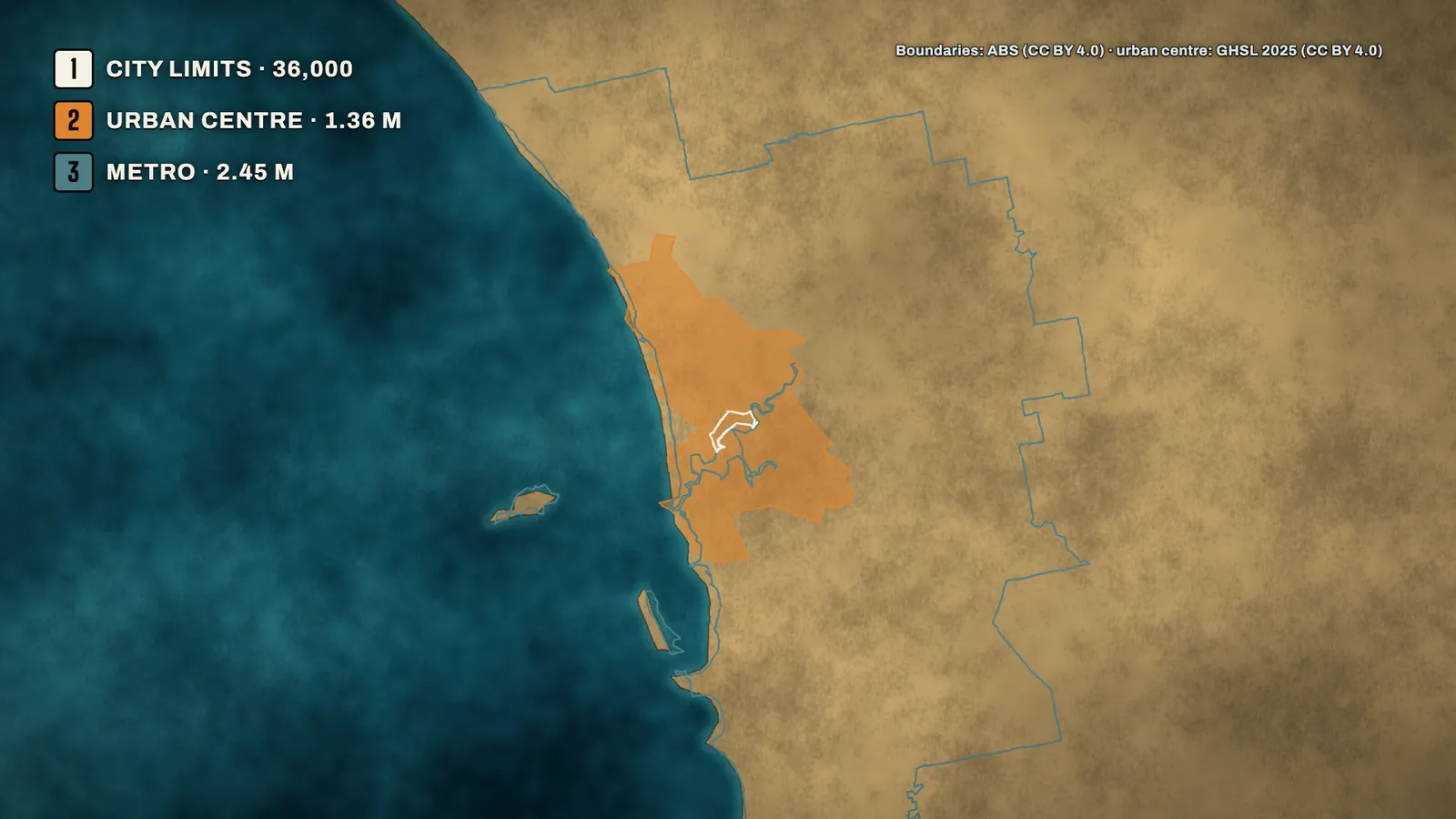
Start with the city limits. The City of Perth, the council itself, covers 13.7 km² and had 35,673 residents in June 2025 [16][17]. Every big city spills far past its limits, so statisticians use two wider shapes. A metro area is a city plus its commuting zone, the towns around it from which people travel in to work [4]. Greater Perth stretches about 150 km along the coast [17].
The second shape is the city as it looks from above. An urban centre is a continuous patch of square kilometres with at least 1,500 inhabitants each, holding at least 50,000 people in all [18]. Researchers at the European Commission's Joint Research Centre map them for the whole world, joining satellite images of buildings with census counts [18][3]. Perth's urban centre had about 1.36 million people in 2025 [3]. From above, some famous cities merge: Tokyo, Yokohama and Saitama form one urban centre of about 33 million [3]. That is why rankings disagree. Most use the figures each country reports, and countries draw their cities differently [5][7].
How did we measure every big city?
We took the GHSL Urban Centre Database 2025 (GHS-UCDB R2024A), multitemporal layer V1.2 (MTUC, 2025 epoch): 11,686 urban centres, 524 of them with at least a million people [3]. For each one, we found the nearest other urban centre of at least the same size, centre to centre along the curve of the Earth [3].
Most big cities are not lonely at all. Half of them have a neighbour of a million within 136 km, and two capitals, Kinshasa and Brazzaville, face each other across the Congo River [3][18]. Only two are more than 2,000 km from the next. One is Auckland, 2,172 km from Sydney [3][19]. The other is Perth, but its nearest city of a million is not Adelaide. It is Denpasar, on Bali, in Indonesia, 2,590 km away [3].
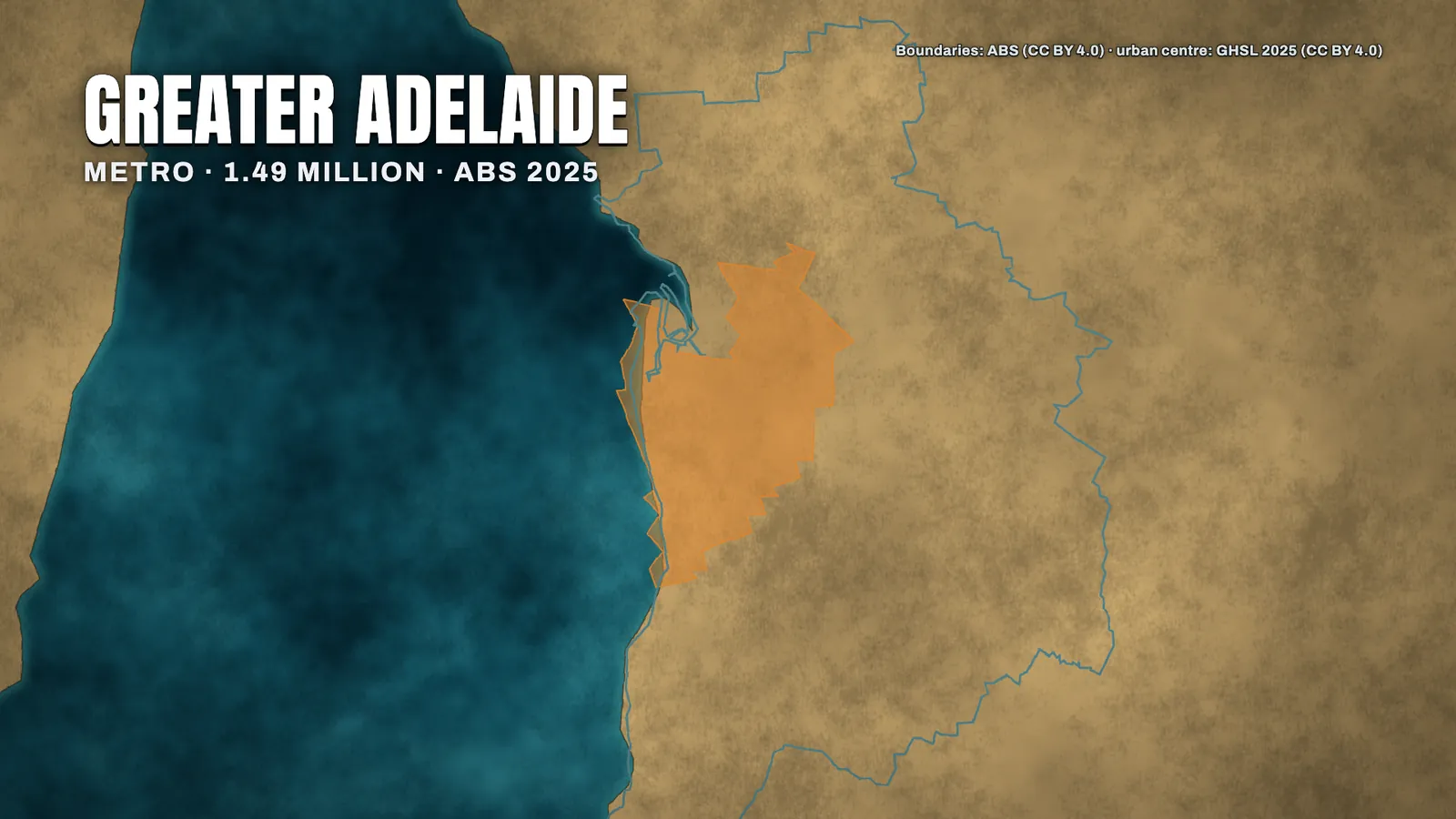
Why Bali? Adelaide's urban centre had 938,328 people in 2025, 61,672 short of a million, even though Greater Adelaide, its official metro area, had 1,491,015 [3][15]. So, counting cities as they look from above, Perth is the loneliest big city, 418 km ahead of Auckland [3]. Measuring edge to edge, or using the 2020 estimates or the 2030 projections, does not change that [3].
What happens when you move the bar?
First lever: what counts as a city. Switch to metro areas, the GHSL functional urban areas of 2015, and Adelaide's commuter towns lift it back over a million [4]. Perth's nearest big city is Adelaide again, 2,137 km away, while Auckland is 2,179 km from Sydney. Auckland wins, by 42 km: about one marathon [3][4][20]. Others got there before us. The ranking site cityextremes.com, from UN city data, and demographers at .id in 2012 also put Auckland just ahead [19][7][2].
Second lever: the bar itself. Lower it to half a million, and Honolulu takes the crown: its nearest urban centre of that size is San Francisco, 3,871 km away, 1,699 km more than the runner-up, Auckland [3][19]. Honolulu is not famous for it because, counted as a whole metro area, it sits on the edge of a million. The US census counted 1,016,508 people in the Urban Honolulu metro area in 2020; the estimate for July 2025 is 988,703 [21][22].
Raise the bar instead, and the crown keeps moving. At two million it goes to Antananarivo, the capital of Madagascar, 1,616 km from Dar es Salaam; Madagascar is bigger than mainland France and has just one urban centre of a million [3][23]. Just past four million, Melbourne drops out and Sydney leads, 4,911 km from Surabaya in Indonesia. At five million it is Los Angeles, 2,468 km from Mexico City, because San Francisco's urban centre, with 4,718,349 people, falls just short. From 5,733,043 people it is New York, 3,361 km from Mexico City, and it keeps the crown up to about 14.2 million, apart from a narrow band where Kinshasa holds it [3].
So there isn't one loneliest big city. There is a chain of them, and the threshold decides who holds the crown. Count metro areas instead of urban centres, and the chain runs differently [3][4].
| From (people) | To (people) | Loneliest city | Nearest city at least that size | km | Sources |
|---|---|---|---|---|---|
| 50,000 | 53,721 | Papeete (French Polynesia) | Apia (Samoa) | 2,411 | [3] |
| 53,722 | 67,984 | Honolulu (United States) | San Rafael | 3,852 | [3] |
| 67,985 | 147,436 | Honolulu (United States) | Santa Rosa | 3,853 | [3] |
| 147,437 | 541,957 | Honolulu (United States) | San Francisco | 3,871 | [3] |
| 541,958 | 938,328 | Auckland (New Zealand) | Sydney | 2,172 | [3] |
| 938,329 | 1,357,382 | Perth (Australia) | Denpasar | 2,590 | [3] |
| 1,357,383 | 1,623,898 | Auckland (New Zealand) | Sydney | 2,172 | [3] |
| 1,623,899 | 2,192,375 | Antananarivo (Madagascar) | Dar es Salaam | 1,616 | [3] |
| 2,192,376 | 2,368,805 | Manaus (Brazil) | Caracas | 1,687 | [3] |
| 2,368,806 | 3,247,674 | Antananarivo (Madagascar) | Dar es Salaam | 1,616 | [3] |
| 3,247,675 | 4,010,658 | Lima (Peru) | Bogotá | 1,881 | [3] |
| 4,010,659 | 4,375,394 | Sydney (Australia) | Surabaya | 4,911 | [3] |
| 4,375,395 | 4,718,349 | Johannesburg (South Africa) | Dar es Salaam | 2,455 | [3] |
| 4,718,350 | 5,733,042 | Los Angeles (United States) | Mexico City | 2,468 | [3] |
| 5,733,043 | 12,846,045 | New York (United States) | Mexico City | 3,361 | [3] |
| 12,846,046 | 12,945,683 | Kinshasa (DR Congo) | Cairo | 4,192 | [3] |
| 12,945,684 | 14,179,912 | New York (United States) | Mexico City | 3,361 | [3] |
Which is the loneliest big city by road?
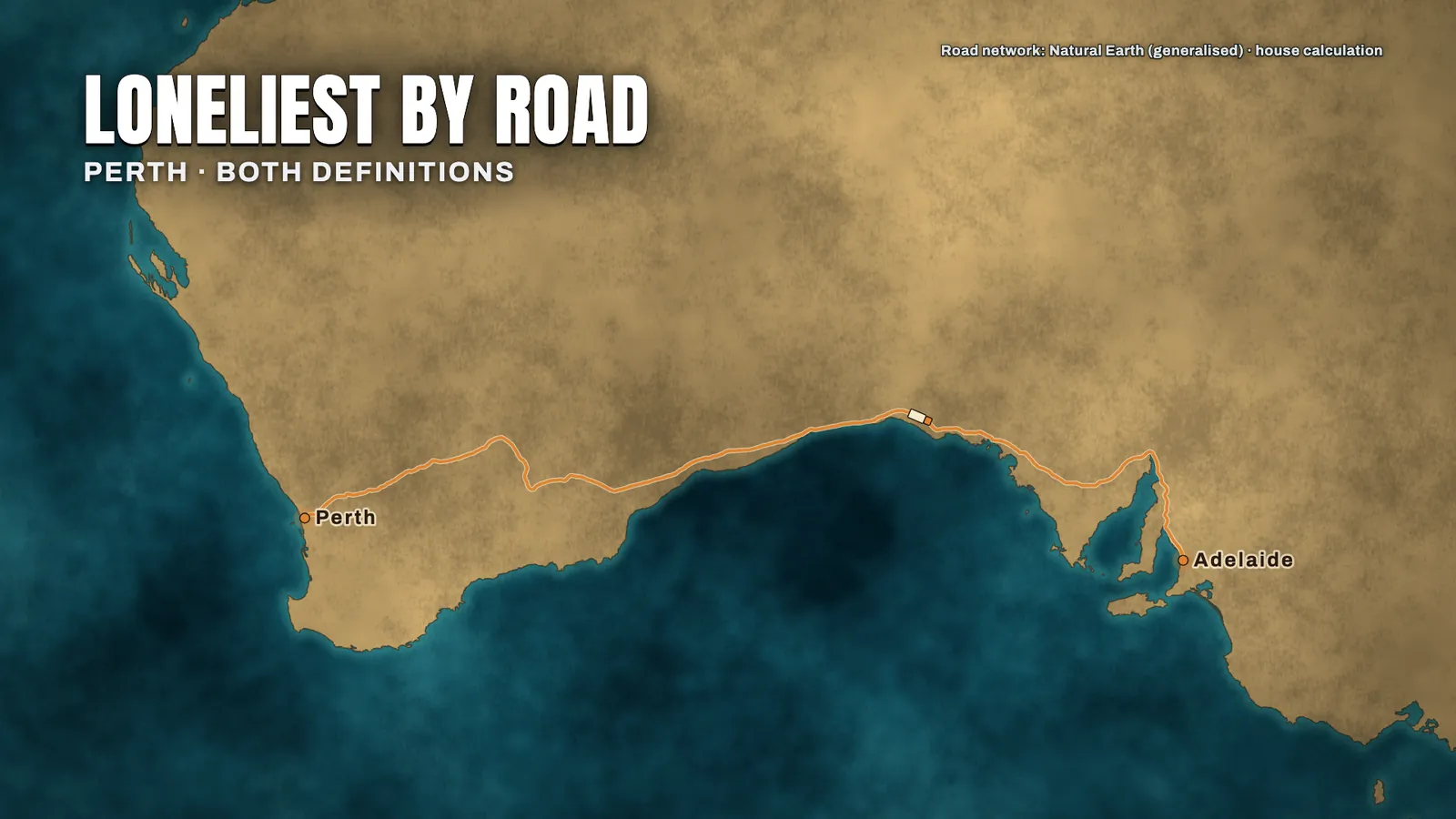
Nobody travels in a perfectly straight line, so we ran the same test on Natural Earth's world map of major roads, ferries left out [24]. Auckland and Honolulu drop out at once: you can't drive from either to another big city. And Perth gets its crown back. Count urban centres or metro areas: either way, it is the loneliest big city you can drive to [24]. Natural Earth's roads are generalised, but none of the gaps we checked could lift another city above Perth [24].
The drive to Adelaide is about 2,700 km, much of it across the Nullarbor [24][25]. On the way, the 90 Mile Straight on the Eyre Highway runs 146.6 km without a bend [26][25]. Roadhouses along the highway keep it going, with fuel, food and a bed for the night [26][25][27].
What does distance do to a city?
Greater Perth holds four in five Western Australians [15]. Auckland holds about a third of New Zealand: about 1.8 million of 5.3 million people in June 2025 [28][29]. Urban Honolulu holds more than two in three people in Hawaiʻi, 988,703 of 1,432,820 [21][30]. And people keep coming: in the year to June 2025, Perth was Australia's fastest-growing capital city, at 2.4% [31].
What about smaller places?
Lower the bar to 50,000, the smallest size that still counts as an urban centre, and the answer drifts out to sea: Papeete, the capital of French Polynesia, on Tahiti, 2,411 km from Apia in Samoa [3][18]. Pacific Islanders were voyaging across East Polynesia after 1000 CE [32], centuries before Magellan sailed into the Pacific in 1520 [33]. In 1976 the Hawaiian voyaging canoe Hōkūleʻa sailed from Hawaiʻi to Tahiti by traditional navigation, without instruments; an escort boat sailed with it. Its navigator, Mau Piailug, from the island of Satawal in Micronesia, read the stars, the wind and the ocean swells. When it reached Papeete on 4 June 1976, an estimated 17,000 people were waiting [34][35].
Forget size altogether and ask which village lies farthest from any other, and the usual answer is Edinburgh of the Seven Seas, on Tristan da Cunha in the South Atlantic [36][37]. About 200 islanders live there (201 on 21 October 2026), and their nearest neighbours, on St Helena, are 2,437 km away [38][39]. There is no airport; the ship from Cape Town normally takes six days [39][40]. The islanders farm, with potatoes the main crop, fish for crawfish sold as Tristan Rock Lobster, and sell stamps to collectors around the world [41].
So which is the loneliest big city?
Count cities as they look from above, at a million people: Perth, by about 400 km. Count whole metro areas: Auckland, by about a marathon. Lower the bar to half a million: Honolulu, by a long way. And if you're driving, Perth again [3][4][24]. The famous claim isn't wrong. It is one answer out of several, and the definition chooses which.
What the video left out
- Singapore. Britannica's sentence goes on to say Perth is closer in distance and time zone to Jakarta and Singapore than to Sydney. For Singapore that holds for the time zone only: by our calculation Perth is 3,911 km from Singapore [1][3].
- Honolulu's million. The Urban Honolulu metro area was over a million in the 2020 census and in the estimates for July 2020 and 2021, and has been just under it since July 2022 [21].
Corrections
No corrections as of 4 December 2026. Found an error? Send the paragraph and your source through our corrections page; confirmed fixes are listed here with their date.
Sources
- Western Australia (print article). Encyclopaedia Britannica (reference).
- Is Perth the most remote city in the world? (Glenn Capuano, lead demographer). .id (informed decisions), 2012 (secondary).
- GHS Urban Centre Database 2025 (GHS-UCDB R2024A), multitemporal layer, V1.2; nearest-neighbour distances, thresholds and the table computed by Causeway Atlas (research/i11_rerun.py, research/exact_sweep.py). European Commission, Joint Research Centre (Mari Rivero et al. 2024; CC BY 4.0), computed 21-22 Oct 2026 (primary, data, derived).
- GHS Functional Urban Areas 2015 (GHS-FUA R2019A) and documentation; metro-area distances computed by Causeway Atlas. European Commission, Joint Research Centre (Schiavina, Moreno-Monroy, Maffenini, Veneri 2019; CC BY 4.0) (primary, data, derived).
- Demographic Yearbook 2023, Technical notes to Table 8 (population of capital cities and cities of 100,000 or more). United Nations Statistics Division (official).
- Our history. Visit Perth (City of Perth) (official).
- Distance to next closest city with over 1 million people. cityextremes.com (secondary).
- Noongar (Koorah, Nitja, Boordahwan) (Past, Present, Future) Recognition Act 2016%20(Past%20Present%20Future)%20Recognition%20Act%202016%20-%20%5B00-b0-02%5D.html). Parliament of Western Australia (legislation.wa.gov.au) (official).
- Burswood Park brings Swan River stories to life with new cultural interpretation node (5 Nov 2024). Department of Biodiversity, Conservation and Attractions (WA) (official).
- Defining Moments: Trans-Australian Railway. National Museum of Australia (official).
- Republic of Western Australia? How the west has always charted its own course (David Lee, 6 Jan 2022). UNSW Sydney Newsroom (secondary, university news, by a historian).
- Trans-Australian Railway workers camp (learning resource). National Archives of Australia (official).
- Western Australian Secession Referendum (timeline event). Parliamentary Education Office (Parliament of Australia) (official).
- Should I stay or should I go? The secession movement. State Library of Western Australia (official).
- Estimated resident population by Greater Capital City Statistical Area and state, 30 June 2025 (ABS data API). Australian Bureau of Statistics (CC BY 4.0) (official).
- Estimated resident population by Local Government Area, 30 June 2025 (ABS data API). Australian Bureau of Statistics (CC BY 4.0) (official).
- ASGS digital boundaries: LGA 2025 and GCCSA 2021 (ArcGIS REST); areas and extent read by Causeway Atlas. Australian Bureau of Statistics (CC BY 4.0) (official).
- GHSL Urban Centre Database 2025: documentation (GHSL_UCDB_R2024_V1_2.pdf, in the data package). European Commission, Joint Research Centre (official).
- The World's Most Isolated Cities. cityextremes.com (secondary).
- IAAF Competition Rules: road races (Rule 240). IAAF / World Athletics (copy hosted by BC Athletics) (official rule text, third-party copy).
- Annual estimates of the resident population for Metropolitan and Micropolitan Statistical Areas, Vintage 2025. U.S. Census Bureau, Population Estimates Program (official).
- 2020 census shows Honolulu's population tops 1 million. Honolulu Star-Advertiser (news).
- Natural Earth 1:10m admin-0 via world-atlas 2.0 (countries-10m); areas of Madagascar and mainland France computed by Causeway Atlas. Natural Earth / world-atlas (public domain / ISC) (primary, data, derived).
- Natural Earth 1:10m Roads, version 5.0.0; shortest road paths computed by Causeway Atlas (research/i11_roads.py, ferries excluded). Natural Earth (public domain), computed 21 Oct 2026 (primary, data, derived).
- Adelaide to Perth road trip. NRMA (Open Road) (secondary).
- Eyre Highway and the Nullarbor Plain. Australia's Golden Outback (regional tourism organisation, Tourism WA) (official, regional tourism).
- Eyre Highway (roadhouses). Australia's Golden Outback (official).
- Subnational population estimates: At 30 June 2025. Stats NZ (official).
- Population growth slows in all regions (Stats NZ media release, 29 Oct 2025). Stats NZ, via Scoop (official).
- Annual estimates of the resident population for the United States and states, Vintage 2025. U.S. Census Bureau (official).
- Regional Population, 2024-25 (key data release). Centre for Population, Australian Government (official).
- Pacific migrations (Te Ara, the Encyclopedia of New Zealand). Manatū Taonga Ministry for Culture and Heritage (reference).
- Strait of Magellan (print article). Encyclopaedia Britannica (reference).
- Polynesian Voyaging Society honors the 50th anniversary of Hokule'a's 1976 maiden voyage to Tahiti. Polynesian Voyaging Society (official).
- 50 years after Hokule'a's first voyage, the canoe continues to reshape Hawaii (4 May 2026). Hawaii Tribune-Herald (news).
- Tristan da Cunha (home page). Tristan da Cunha Government and Tristan da Cunha Association (official).
- What's the most remote inhabited place on Earth? (Luis Villazon). BBC Science Focus (secondary).
- Population update (checked 21 Oct 2026). Tristan da Cunha Government and Tristan da Cunha Association (official).
- Visits: getting to Tristan. Tristan da Cunha Government and Tristan da Cunha Association (official).
- Shipping: an epic journey. Tristan da Cunha Government and Tristan da Cunha Association (official).
- Economy and Farming pages. Tristan da Cunha Government and Tristan da Cunha Association (official).
Watch the video
Prof. Mercer's video is coming soon. Subscribe on YouTube to see it first.
The player loads from YouTube only after you press play. See our privacy policy.
Chapters
- 0:00Intro
- 0:49The Famous Claim
- 2:07What Counts as a City?
- 3:24Measuring Every City
- 4:44Move the Bar
- 7:03By Road
- 8:30Lonelier Still
- 9:54Back to the Map