
Why Do 95% of Egyptians Live on 5% of the Land?
About 95% of Egyptians live on less than 5% of the land, beside the Nile. Why: almost no rain, one river, and new cities still waiting for people.
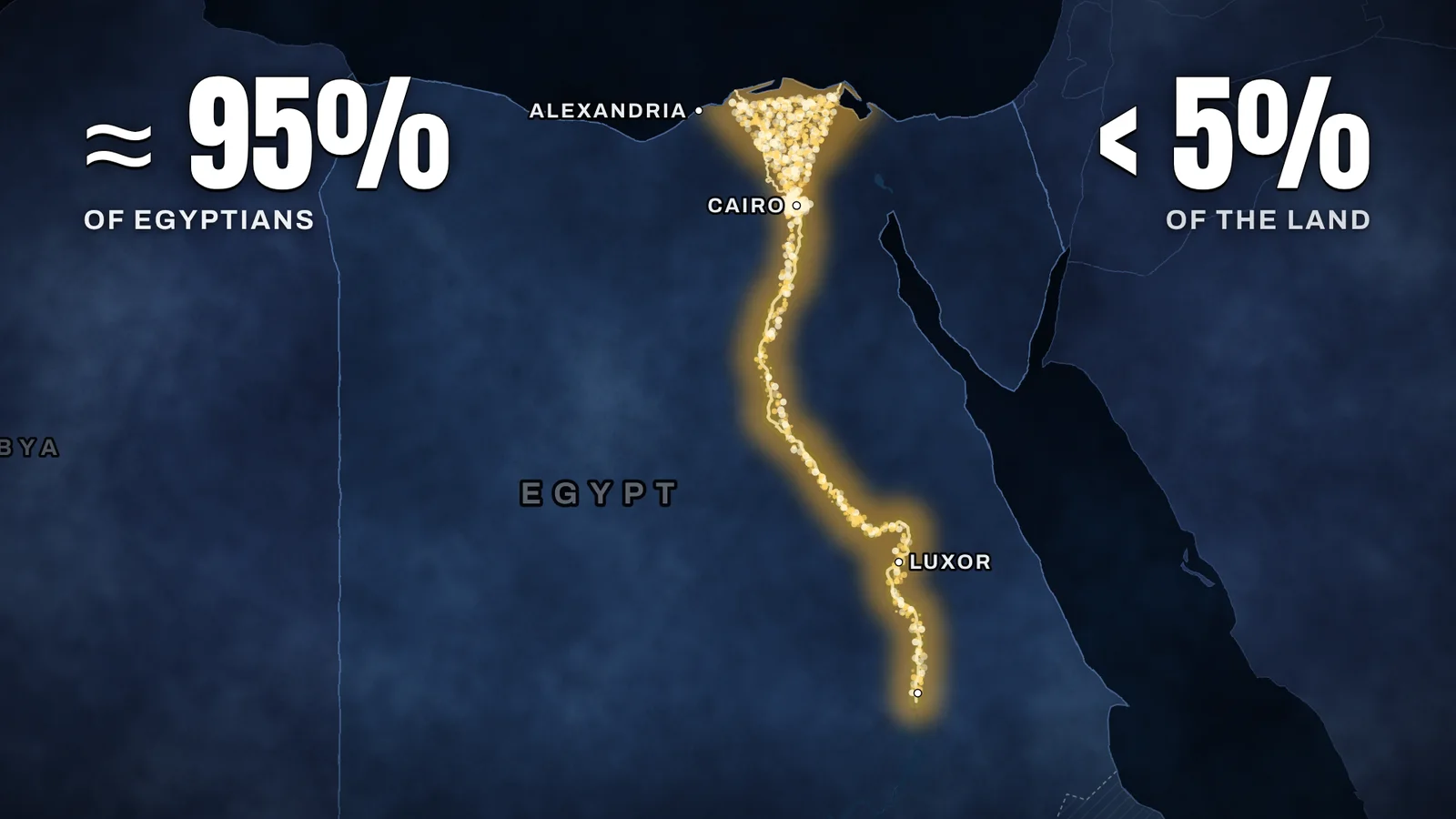
Because Egypt gets almost no rain, and the Nile supplies nearly all of its water. About 95% of Egyptians live within roughly 20 km of the Nile or its delta [1], and the valley and delta together cover less than 5% of the country's land [6]. Everything else is mostly desert. For thousands of years, homes, farms and cities grew up along the one reliable source of water. Dams, a desert canal and dozens of new cities have since tried to redraw that map. So far, the thin line still holds.
How much of Egypt do people actually live on?
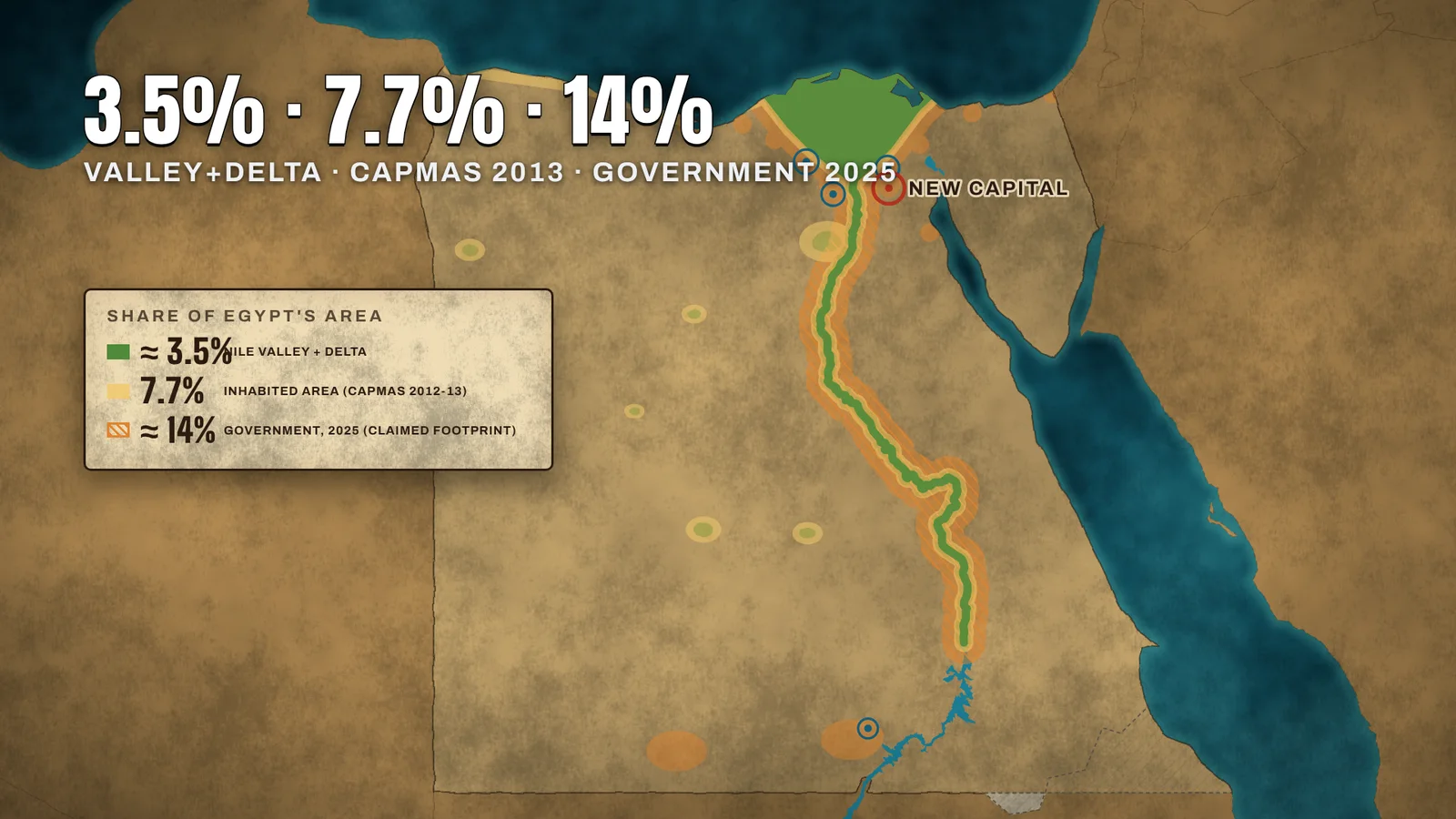
Very little. Egypt covers 1,001,450 km², more than mainland France and Germany combined [2][3][4]. The Nile valley and delta, the land that is cultivated and permanently settled, add up to about 35,000 km²: roughly 3.5% of the country [17][19]. Between Cairo and Aswan the cultivated valley is only 8 to 16 km wide [19], a strip you could, in places, cross on foot in an afternoon.
CAPMAS, Egypt's statistics agency, puts the national average at about 108 people per km² [12]; its population clock showed 109,540,965 residents on 19 September 2026 [10][11]. Fit nearly everyone into the valley and delta and the figure passes 2,000 per km²: more than three times the Netherlands, and well above Bangladesh [39][40]. The table gives the range.
| Measure | Figure | Sources |
|---|---|---|
| Egypt's area | 1,001,450 km² | [2] |
| Mainland France + Germany | about 901,000 to 909,200 km² | [3][4][42][43] |
| Residents (CAPMAS clock, 19 Sep 2026) | 109,540,965 | [10][11] |
| People within ~20 km of the Nile or its delta | about 95% | [1] |
| People in the valley and delta (NASA, FAO) | roughly 97% | [6][7] |
| Valley and delta, share of Egypt's land | about 3.5% (under 5% on every definition) | [6][17][19] |
| Western Desert, share of Egypt | about two-thirds | [37] |
| Population density, national (2026) | about 108 per km² | [12] |
| Population density, valley and delta | more than 2,000 per km² (about 2,100 to 3,000) | [1][6][7][10][19] |
| Population density, Netherlands (2024) | 533 per km² | [39] |
| Population density, Bangladesh (2022 census) | 1,119 per km² | [40][41] |
| Rain in Cairo | less than 3 cm a year (sources: a little over 1 cm to 2.5 cm) | [33][34] |
| Rain in Alexandria | about 12 to 20 cm a year | [33][8] |
| Nile water that starts in the Ethiopian highlands | roughly 85% | [35][33] |
| Egypt's water that comes from the Nile | about 98% | [45][33] |
| Egypt's Nile share (1959 agreement with Sudan) | 55.5 billion m³ a year | [7][8] |
| Water per person per year | about 2,000 m³ (1960), about 500 m³ (today) | [44][45] |
| New desert cities | 49 (around 50) | [62][9] |
| New capital: planned vs living there | at least 6 million planned; more than 30,000 residents (July 2026) | [65][84] |
Why don't Egyptians live in the desert?
Because there is almost no rain out there, and no other river [8][93]. About two-thirds of the country is the Western Desert, the north-eastern corner of the Sahara [37][38]. Rainfall ranges from about 0 mm a year in the desert to about 200 mm on the north coast [8]. Cairo gets less than 3 cm in an average year [33][34]. Alexandria, on the wetter Mediterranean coast, gets about 20 cm at most, and near Aswan the total rounds down to almost nothing [33][7].
Where does Egypt's water come from?
From rain in another country. Roughly 85% of the Nile's water starts as summer rain in the Ethiopian highlands [35][33]. The Blue Nile alone brings more than half; the White Nile, from equatorial Africa, adds far less [35][36]. Inside Egypt, the river supplies nearly all the water: Egypt's irrigation minister put it at 98% of the country's water resources [45].
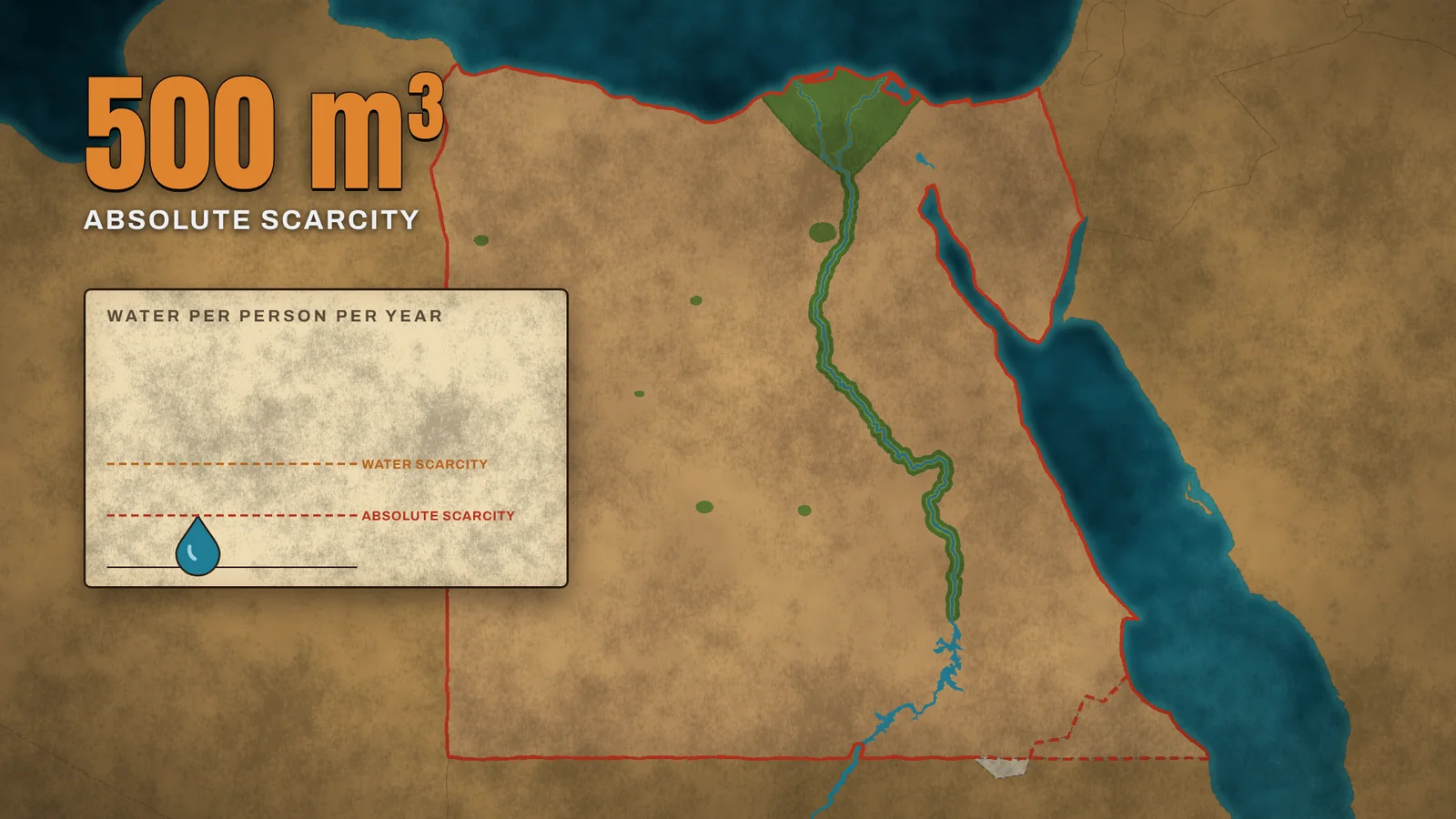
That water is shared. Under a 1959 agreement with Sudan, Egypt's share is 55.5 billion m³ a year, and it has not changed since [7][8]. The population has: it has more than tripled since the 1960s [80][10]. In 1960 the share came to around 2,000 m³ per person a year; today it is around 500 [44][45]. Below 1,000 m³, hydrologists speak of water scarcity, and below 500 of absolute scarcity [46][82]. Egypt sits right on that line.
Why is Egypt called "the gift of the Nile"?
Because the river built the farmland, one flood at a time. About 2,500 years ago the Greek writer Herodotus described the Egypt the Greeks sailed to as land "acquired by the Egyptians, given them by the river" [29][30]. "The gift of the Nile" is the later, shorter version of his line.
For thousands of years the Nile flooded every year at a predictable season; in Egypt the flood usually came in August, September and October [18][22]. Summer rain in Ethiopia sent the water and its silt down the valley [22][35]. Ancient Egyptians organised their year around it in three seasons: Akhet, the Inundation; Peret, the Emergence; and Shemu, the Harvest [22][23]. Farmers divided the floodplain into large basins with earth banks, let the floodwater stand for about a month, then drained it, leaving fresh, fertile silt for one crop a year [20][21]. Officials measured the flood on nilometers, because its height predicted the harvest and was used to set taxes [26][27].
People settled where the gift arrived, in a long chain of villages along the water: the glowing line on today's night map.
How did the Aswan High Dam change Egypt?
It tamed the river, but it did not move the people. The flood was unreliable: some years brought too little water, others far too much [33]. A first dam at Aswan, finished by British engineers in 1902 and raised twice, still could not store enough [47][52]. Egypt's answer, built between 1960 and 1970, was the Aswan High Dam [47][48][49]. Behind it grew Lake Nasser, nearly 500 km long, which lets Egypt store water from good years for bad ones [47][48][49]; its southern third, in Sudan, is called Lake Nubia [81]. The yearly flood stopped in 1970, and farmers could irrigate all year and grow two or three crops instead of one [53][19].
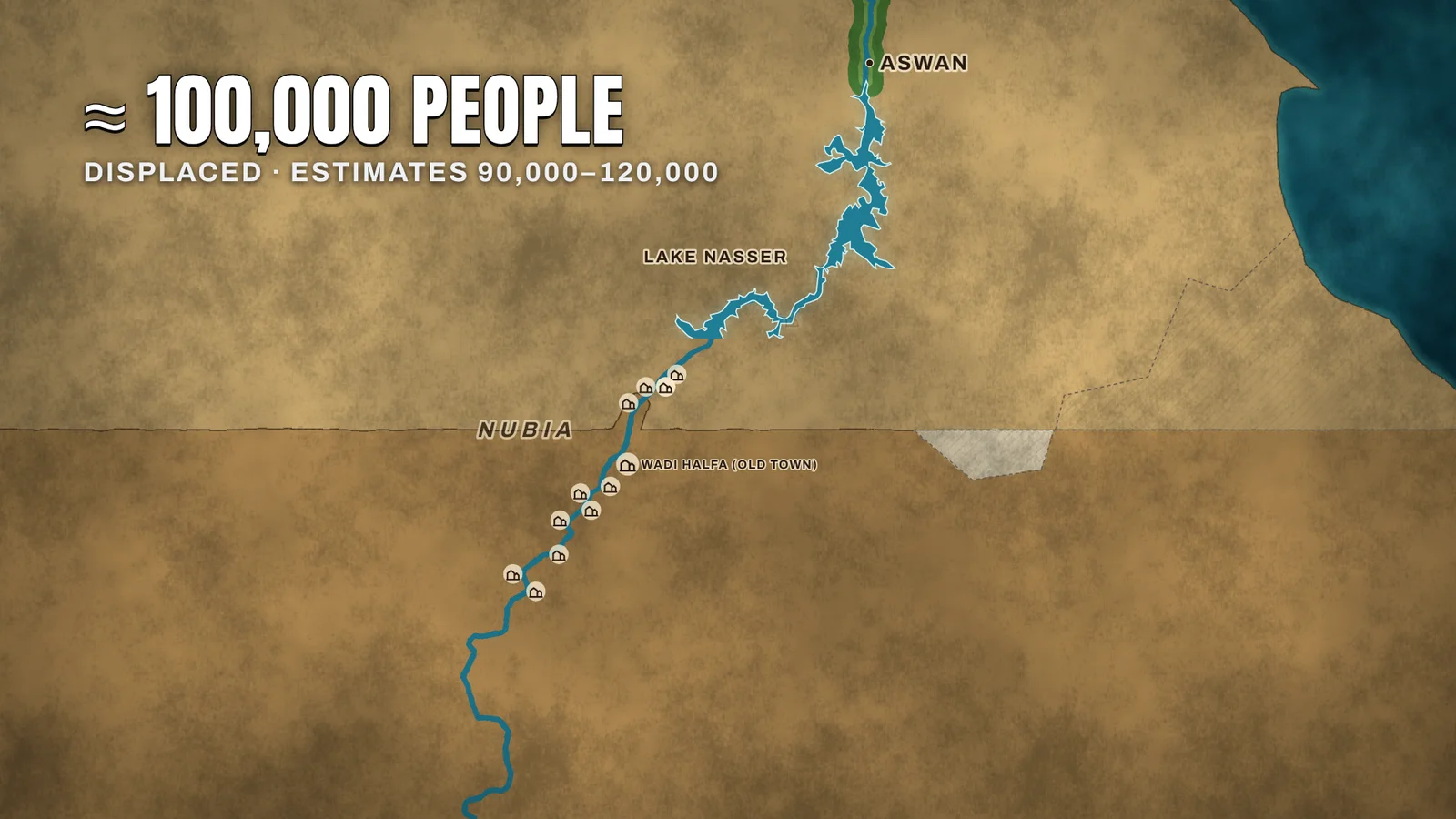
The lake came at a price. It flooded much of old Nubia: roughly 100,000 people, most of them Nubians, lost their homes and villages in Egypt and Sudan [47][49][50]. The great temples of Abu Simbel had to be moved [47][81]. The silt that once reached the fields now settles behind the dam; farmers switched to fertiliser, and the delta's coast lost its supply of fresh sediment [18][47][54].
Why are Egypt's new desert cities so empty?
Because homes are only part of a city. Egypt began building desert cities in the late 1970s, starting with 10th of Ramadan, 6th of October and Sadat City; today there are around 50 [62][59][9]. Together they were planned for well over 20 million people [9][60]. Official figures suggest many hold less than a fifth of their target [9]. About a decade ago, the economist and urban planner David Sims estimated that well over half the homes in the new towns stood empty: at least 60%, he said in 2015 [61][60].
Two bolder bets followed. In 1997 Egypt launched the Toshka project, pumping Lake Nasser's water into the desert to farm it and to draw people away from the crowded valley [70][71][69]. By 2012 critics were calling it a mega-failure [70]; it has since been revived, and satellite images show its fields spreading [69][71]. In 2015 Egypt announced a new capital about 45 km east of Cairo, planned for at least 6 million people at an estimated cost of tens of billions of dollars [64][65]. Ministries began relocating there in 2023 [83][66]. Permanent residents so far: tens of thousands. Asharq Al-Awsat reported more than 30,000 in July 2026 [84].
Why don't people follow? Many new cities still lack enough jobs, good schools, healthcare and public transport, and housing and commuting costs remain high [9][60][63]. The valley has family, neighbours and water that arrives by canal; in the desert, every drop has to be pumped or piped in, and paid for [18][72].
Will Egypt's population map ever change?
Slowly, and under pressure from both ends of the river. The government says Egypt's inhabited area has already doubled since 2014, to about 14% [15]. But building on land is not the same as living on it: in 2026, ECES still described more than 95% of Egyptians living on less than 4% of the land [9].
In the north, parts of the delta are sinking by several millimetres a year, starved of silt and pumped for groundwater and gas; in places that is faster than the sea is rising [54][55][57]. In the south, Ethiopia inaugurated the Grand Ethiopian Renaissance Dam in 2025. Its reservoir, 74 billion m³, can hold more than Egypt's entire yearly share of the Nile [75][76]. Ethiopia says it needs the dam's power for development, with tens of millions of Ethiopians still lacking electricity (56.4 million in 2023), and that the dam will not harm anyone downstream [75][76][92][91]. Egypt, backed by Sudan, wants a binding agreement on how the dam is filled and run, fearing what a long drought could do [75][78][85]. As of 12 October 2026, there is no such agreement [86][87].
What the video left out
- The 95% is the cautious figure. The CIA's estimate is "approximately 95%" within 20 km of the Nile and its delta [1]. NASA and the FAO put the share living in the valley and delta at roughly 97% [6][7].
- "Inhabited" depends on who is measuring. The valley and delta are about 3.5% of Egypt [17]. CAPMAS worked with an inhabited area of 7.7% in 2012 and 2013 [13][14]. The government's 2025 figure is 14% [15], yet in November 2024 an official platform still described 14% as a target [88].
- Herodotus meant mainly the delta. His "Egypt to which the Greeks sail" was chiefly Lower Egypt, and his Greek says "gift of the river" [29][30].
- The flood swung wildly. In the 20th century the yearly flow at Aswan ranged from about 42 to nearly 150 billion m³ [33]. The High Dam's reservoir holds 169 billion m³ gross, about two years of average flow [47][33].
- Where did the Nubians go? Most of the valley's inhabitants were resettled, mainly in government-built villages called New Nubia [50].
- You can still visit a nilometer. The one on Roda Island in Cairo dates from AD 861 [26][27][28].
- How fast is "several millimetres"? Measurements range from about 3.7 mm a year in the north-west of the delta to 8.4 mm in the north-east [54]. A 2026 study in Nature found that the Nile delta's average sinking exceeds today's global sea-level rise of about 4 mm a year [55].
Corrections
No corrections as of 12 October 2026. Found an error? Send the paragraph and your source through our corrections page; confirmed fixes are listed here with their date.
Sources
- The World Factbook: Egypt (People and Society, population distribution; final edition before the Factbook was sunset on 4 Feb 2026). Central Intelligence Agency (text via the factbook.json data mirror of the CIA site; same text verbatim on openfactbook.org, which is a community "successor" that mixes CIA, World Bank and REST Countries data) (reference).
- The World Factbook: Egypt (Geography, area; final 2025 edition, mirror). Central Intelligence Agency, The World Factbook (unofficial mirror factbook.dmcc.io; the Factbook was sunset on 4 Feb 2026) (reference).
- The World Factbook: France (area; mirror). Central Intelligence Agency, The World Factbook (unofficial mirror factbook.dmcc.io; the Factbook was sunset on 4 Feb 2026) (reference).
- The World Factbook: Germany (area; mirror). Central Intelligence Agency, The World Factbook (unofficial mirror factbook.dmcc.io; the Factbook was sunset on 4 Feb 2026) (reference).
- About Egypt. Embassy of the Arab Republic of Egypt, Berlin (official).
- City Lights Illuminate the Nile (Image of the Day, 2012). NASA Earth Observatory (official).
- AQUASTAT country profile: Egypt (2005). FAO (official).
- Irrigation in the Near East region in figures: Egypt, geography and population (1997). FAO (official).
- Economic Lens, Issue 20: Egypt's new cities (Aug 2026). Egyptian Center for Economic Studies (ECES) (academic).
- Egypt's domestic population reaches 109.5 million: CAPMAS (19 Sep 2026). Egypt Today (news).
- CAPMAS population clock report (19 Sep 2026, Arabic). Al-Bawaba News (news).
- Egypt projected to become world's 11th most populous country by 2050: CAPMAS (11 Jul 2026). Ahram Online (news).
- Egypt population reaches 91 million (30 Aug 2012), citing CAPMAS. Ahram Online (news).
- CAPMAS population distribution indicators (27 Feb 2013). Egypt Independent (news).
- Egypt doubles inhabited land to 14% as urban expansion accelerates: Housing Minister (22 Jun 2025). Amwal Al Ghad (news).
- Housing minister: inhabited area under Sisi rose from 7 to 14% (Arabic, 3 Feb 2021; the body describes an investment PLAN to double the inhabited area to 14%). Akhbar El-Yom (news).
- Egypt: A Country Study, Geography (ed. H. C. Metz, 1991; research completed Dec 1990). Library of Congress, Federal Research Division (mirror: countrystudies.us; original record https://www.loc.gov/item/91029876/) (reference).
- Egypt: A Country Study, The Nile (ed. H. C. Metz, 1991; research completed Dec 1990). Library of Congress, Federal Research Division (mirror: countrystudies.us; original record https://www.loc.gov/item/91029876/) (reference).
- Egypt: Land (the Nile delta). Encyclopaedia Britannica (reference).
- Basin system (irrigation). Encyclopaedia Britannica (reference).
- Ancient Egypt: water engineering. University of Wisconsin-Madison, Ancient Engineering Technologies (academic).
- Telling Time in Ancient Egypt (Janice Kamrin, 2017). The Metropolitan Museum of Art (academic).
- Calendar, Egyptian (Encyclopedia of Time). SAGE Publications (reference).
- Survivances amarniennes dans la tombe d'Ipouy (TT 217), BIFAO 95 (N. Cherpion, 1995). Institut français d'archéologie orientale (academic).
- Evolution of Water Lifting Devices (Pumps) over the Centuries Worldwide (Yannopoulos et al., Water 7(9), 2015). MDPI Water (academic).
- 4.615 The Architecture of Cairo: Nilometer slide notes. MIT OpenCourseWare / MIT (academic).
- Nilometer of Rhoda Island. Showcaves.com (reference).
- Nilometer (citing Behrens-Abouseif, Islamic Architecture in Cairo, 1992). Wikipedia (reference).
- Herodotus, Histories 2.5 (trans. A. D. Godley, Loeb Classical Library, 1920). LacusCurtius, University of Chicago (primary).
- Herodotus, Histories 2.4.3-2.5.2 (trans. Godley). Perseus / Perseids CTS (primary).
- Herodotus, Greek historian. Encyclopaedia Britannica (reference).
- Herodotus, book 2, logos 4 (J. Lendering). Livius.org (reference).
- Drought condition and management strategies in Egypt (country report, UNW-DPC National Drought Management Policy workshop, 17-20 Oct 2014). Egyptian Meteorological Authority (T. A. Nada), published by UNW-DPC on droughtmanagement.info (official).
- Climate of Egypt: Cairo International Airport climate table (WMO 1991-2020 normals via NOAA). Wikipedia (data: WMO/NOAA) (reference).
- Freshwater Ecoregions of the World: Lower Nile (523). WWF / The Nature Conservancy (FEOW) (academic).
- Blue Nile River. Encyclopaedia Britannica (reference).
- Western Desert. Encyclopaedia Britannica (reference).
- Libyan Desert. Encyclopaedia Britannica (reference).
- Nieuwsbrief Regionaal, augustus 2024. CBS (Statistics Netherlands) (official).
- Bangladesh's population reaches 165 million (BBS Population and Housing Census 2022). Prothom Alo (news).
- Population now at 165.16m (BBS census 2022, 28 Jul 2022). The Financial Express (Bangladesh) (news).
- Superficie cadastrale (Insee data). Observatoire des territoires (ANCT) / Insee (official).
- Fläche und Bevölkerung nach Ländern (2023 area). Statistische Ämter des Bundes und der Länder (official).
- Egypt's per capita water share falls below 500 cubic metres: Irrigation minister (30 Jun 2026). Ahram Online (news).
- Egypt's per capita water falls below half of UN's water scarcity threshold: Minister (10 Feb 2026). Egypt Today (news).
- The measurement of water scarcity: defining a meaningful indicator (Damkjaer & Taylor, Ambio, 2017). Springer / Ambio (academic).
- Aswan High Dam. Encyclopaedia Britannica (reference).
- Aswan High Dam completed (21 July 1970). HISTORY.com (reference).
- Aswan High Dam (citing Scudder & Gay 2005, The Future of Large Dams). Wikipedia (reference).
- Nubian Valley. Encyclopaedia Britannica (reference).
- Documenting Nubian Culture and Traditions. American University in Cairo, Social Research Center (academic).
- Aswan Low Dam. Wikipedia (reference).
- Flooding of the Nile. Wikipedia (reference).
- Increased land subsidence and sea-level rise are submerging Egypt's Nile Delta coastal margin (Stanley & Clemente, GSA Today 27(5), 2017). Geological Society of America (academic).
- Global subsidence of river deltas (Ohenhen et al., Nature 649, 894-901, published online 14 Jan 2026; Author Correction 24 Feb 2026). Nature (academic).
- Major river deltas are sinking faster than sea-level rise (15 Jan 2026). Virginia Tech News (news).
- Researchers use satellite data to calculate how fast the Nile Delta is sinking (Gebremichael et al., JGR Solid Earth 2018). Eos (AGU) (news).
- Evaluating subsidence in the Delta using Radar Interferometry (2015). Western Michigan University, Earth Science Remote Sensing Facility (academic).
- Population Growth Rates in New Cities (2016, rev. 2022; data: CAPMAS 2006 census, NUCA decrees). Built Environment Observatory (Marsad Omran) (academic).
- Egypt's Megafantasies (P. Keddie, review of D. Sims, Egypt's Desert Dreams, 1 May 2015). Los Angeles Review of Books (reference).
- David Sims releases book critical of government's desert development plans (15 Jun 2015). Ahram Online (news).
- New Urban Communities Authority (generations of new towns). Wikipedia (reference).
- The Role of Sustainable Urban Transportation in Occupying the Residents in New Cities in Egypt (Salama & Hamed, ERJ Shoubra 46(1), 2020). Engineering Research Journal (Shoubra), Benha University (academic).
- The New Capital. Wikipedia (reference).
- Everything you need to know about Egypt's new capital city (10 Jun 2025). Dezeen (news).
- Egypt plans massive expansion of new capital as first residents trickle in (Reuters, 4 Jan 2024). Gulf News / Reuters (news).
- Egypt prepares to start move to new administrative capital (17 Mar 2021). Ahram Online (news).
- Egypt's New Administrative Capital rebranded as 'New Capital' (8 Nov 2025). Egypt Today (news).
- Two Decades of Change at Toshka Lakes (18 Jan 2022). NASA Earth Observatory (official).
- On Toshka New Valley's mega-failure (26 Apr 2012). Egypt Independent (news).
- New Valley Project. Wikipedia (reference).
- Huge projects under way to bring water to Egyptian desert. Engineering News-Record (ENR) (news).
- Mubarak Pumping Station, Toshka (2003 project sheet). ABB (primary).
- Mubarak Pumping Station (reference project). Tractebel Engie (primary).
- Grand Ethiopian Renaissance Dam, Ethiopia: update (12 Sep 2025). Engineering News (Creamer Media) (news).
- Grand Ethiopian Renaissance Dam. Wikipedia (reference).
- Ethiopia Inaugurates Grand Renaissance Dam, Africa's Largest Hydro-Power Project (9 Sep 2025). AllAfrica (aggregator; the page does not name the original outlet) (news).
- Egypt refuses return to GERD negotiations without binding guarantees (30 Jun 2026). Egypt Independent (news).
- GERD talks fail again, Egypt says no more negotiations with Ethiopia (20 Dec 2023). Egyptian Streets (news).
- Census in Egypt (CAPMAS census totals). Wikipedia (census table; the table itself names no source, CAPMAS is cited in the references) (reference).
- Lake Nasser. Encyclopaedia Britannica (reference).
- Glossary: absolute water scarcity (E/ESCWA/24/4(Part III)). UN Economic and Social Commission for Western Asia (ESCWA) (official).
- New capital moves (13 Jan 2023). Ahram Online (news).
- Egypt's New Administrative Capital Gains Official Momentum, but Residential Occupancy Remains Limited (16 Jul 2026). Asharq Al-Awsat (English) (news).
- Egypt issues warning to Ethiopia over 'unacceptable' GERD steps (13 Jul 2026). Egypt Independent (news).
- Egyptian Irrigation Minister: GERD is illegitimate and we'll not recognize It (22 Aug 2026). Egypt Independent (news).
- Ethiopia Keeps Building, Egypt Keeps Negotiating: 13 Years and the Nile Crisis Deepens (20 Sep 2026). Zawia3 (English) (news).
- Egypt Showcases Urban Development Achievements and Vision 2030 at African Housing Ministers’ Session (7 Nov 2024). Official Egyptian Real Estate Platform (blogs.realestate.gov.eg), reporting the Housing Minister (official).
- Spotlighting The World Factbook as We Bid a Fond Farewell (4 Feb 2026). Central Intelligence Agency (official).
- CIA ends publication of its popular World Factbook reference tool (AP, Feb 2026). WTOP / Associated Press (news).
- The green paradox of Ethiopia's Renaissance Dam (24 Sep 2025). 360info (news).
- Tracking SDG 7: The Energy Progress Report 2025, Chapter 1: Access to electricity (data year 2023). IEA, IRENA, UN Statistics Division, World Bank and WHO (SDG 7 custodian agencies), hosted by ESMAP/World Bank (official).
- Hydrogeology of Egypt (Africa Groundwater Atlas). British Geological Survey (BGS), Africa Groundwater Atlas (academic).
Watch the video
Prof. Mercer's video is coming soon. Subscribe on YouTube to see it first.
The player loads from YouTube only after you press play. See our privacy policy.
Chapters
- 0:00Intro
- Time to be addedA River in a Sea of Sand
- Time to be addedThe Calendar of the Flood
- Time to be addedTaming the Nile
- Time to be addedCities Waiting for People
- Time to be addedWill the Map Ever Change?