
Who Owns Antarctica?
Seven countries claim slices of Antarctica and three overlap. Since 1961 a treaty has frozen every claim, and no, nothing about it expires in 2048.
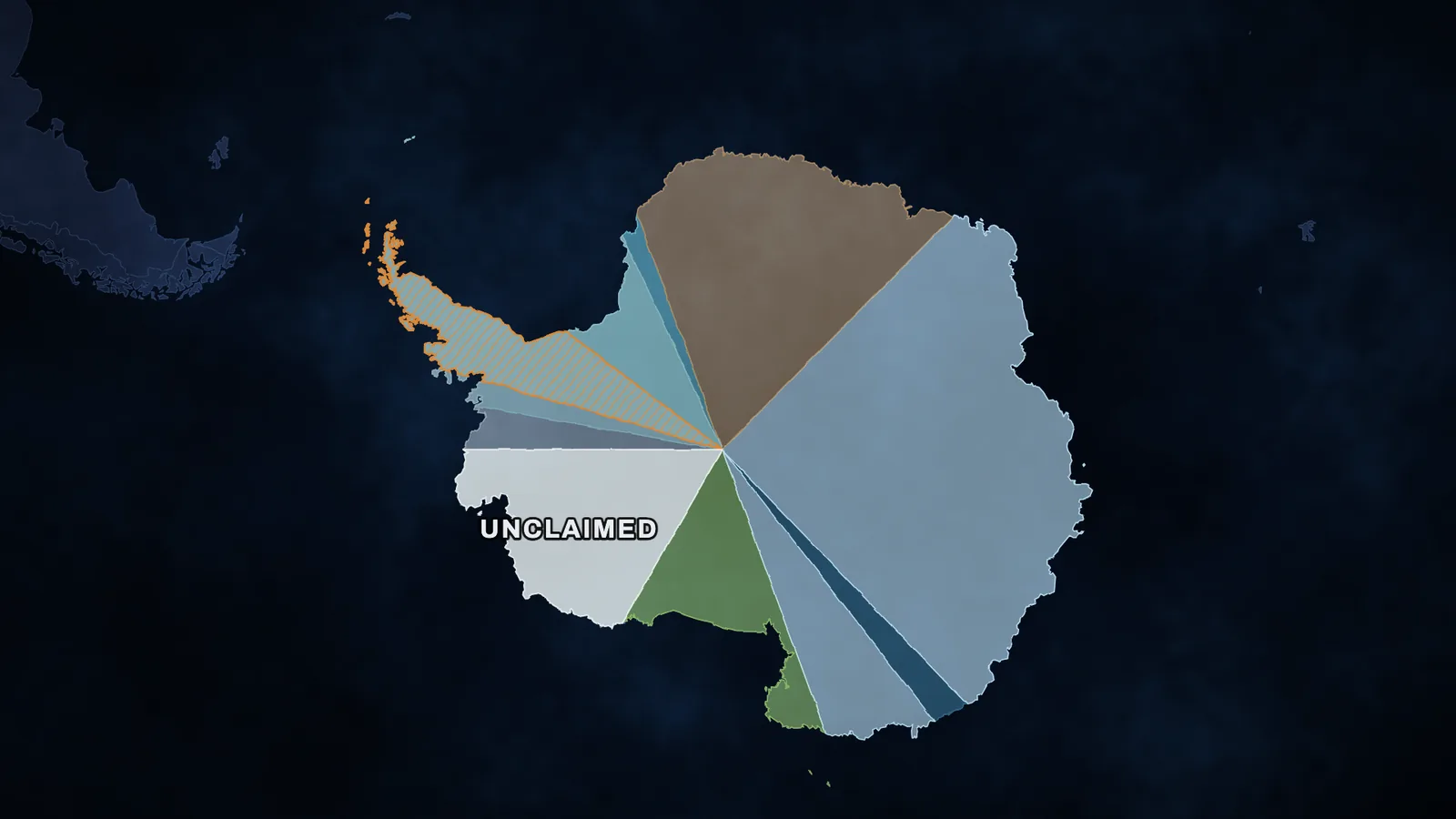
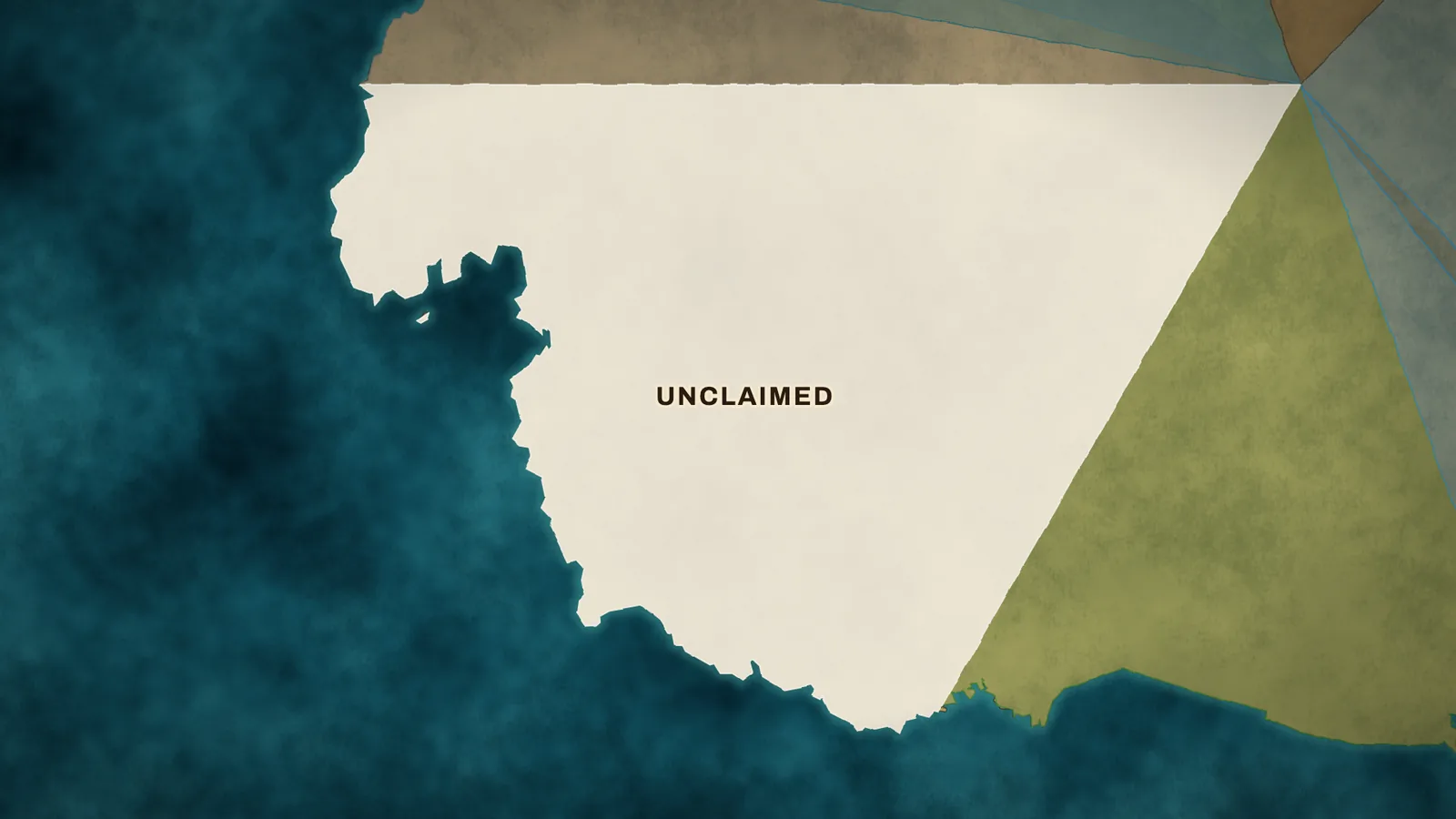
No single country. Seven countries claim slices of Antarctica, and the claims of Argentina, Chile and the United Kingdom overlap on the Antarctic Peninsula [1][2]. One large wedge lies outside every claim on the mainland [2][3]. Since 1961 the Antarctic Treaty has frozen all seven claims [4][5]. And no, nothing expires in 2048 [6][7].
Why can't a world map show Antarctica properly?
On the Mercator projection the poles lie infinitely far away, so the map has to stop somewhere; web maps stop at about 85° [8][9]. Areas stretch more and more towards the poles, about 4 times at 60° S and 33 times at 80° S [8][10]. Cut at 85° S, Antarctica comes out about ten times bigger than Africa. In reality, Africa is more than twice its size [10][11].
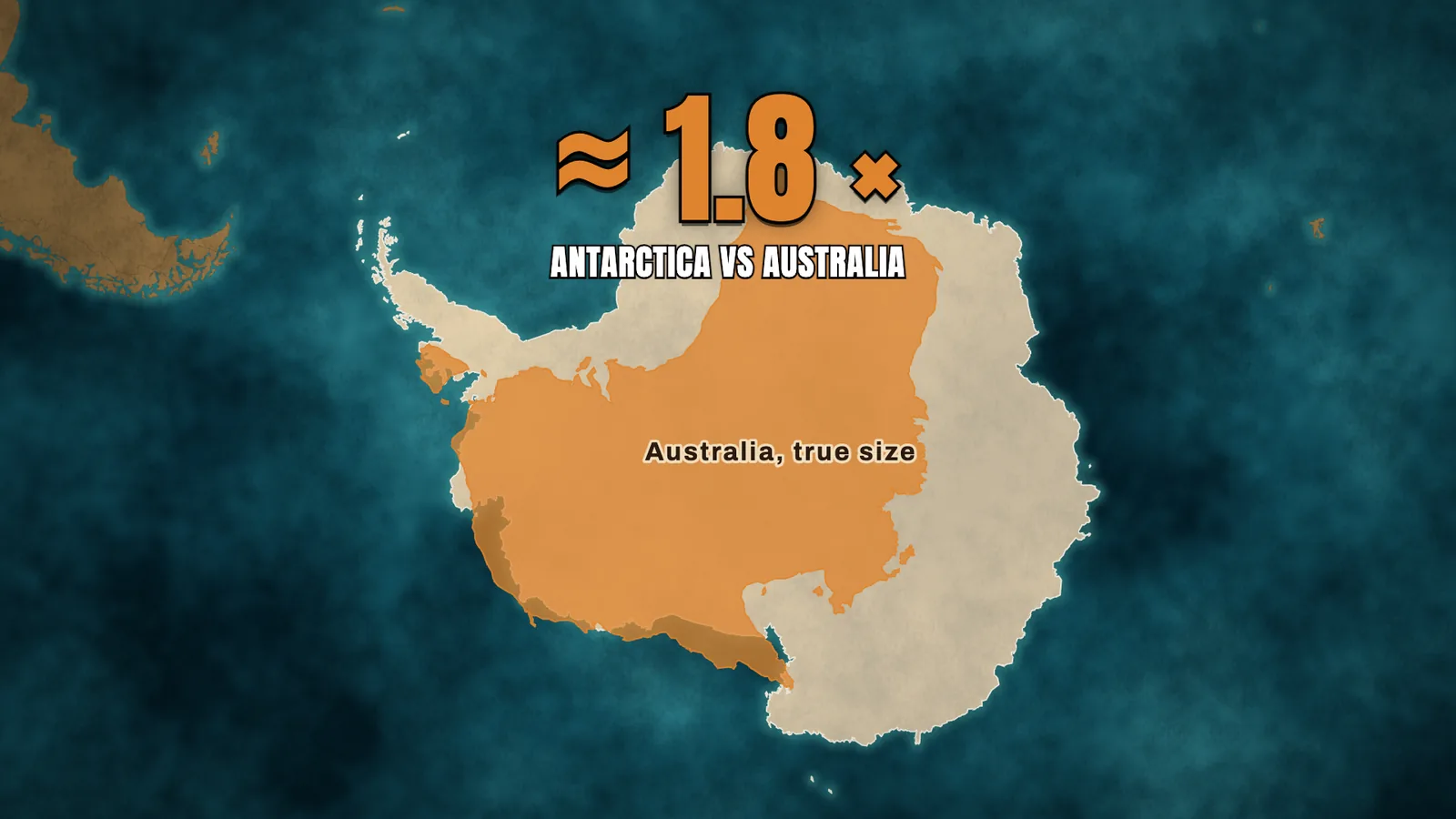
Ice shelves included, Antarctica covers about 14 million km², nearly twice the area of Australia [12][13]. Only about 0.18% of it is exposed rock [14]. It has no Indigenous people, and nobody lived there until the twentieth century [15][16].
Who claims Antarctica, and since when?
In 1908, British Letters Patent, a formal royal order, set out a claim to islands and land south of 50° S between 20° and 80° W [2][17]. Read literally, that wording also took in the southern tip of South America, including parts of Argentina and Chile [18][10]. New Letters Patent in 1917 redrew the definition as sectors, and the South American land fell outside it [2][18].
New Zealand's Ross Dependency followed in 1923, France's Adélie Land in 1924 and the Australian Antarctic Territory in 1933 [2][19][20]. Most claims are slices between two meridians that meet at the South Pole [2][21]. Australia's is the largest, about 42% of Antarctica; much of it rests on the expeditions of Douglas Mawson, who claimed it for the British Crown [20].
Norway's slice came in a hurry. Its shipowners feared being shut out of the Southern Ocean's whaling grounds, and in December 1938 Norway learned that a German expedition was on its way [22]. On 14 January 1939 it placed Dronning Maud Land (Queen Maud Land) under Norwegian sovereignty [22][2]; the German ship reached the ice edge five days later [23]. Since a 2015 report to Norway's parliament, the claim has been read as reaching the South Pole, a reading Norway has not opposed [2][24].
During the Second World War, Chile and Argentina defined claims of their own: Chile by a decree of 6 November 1940, Argentina in 1943 according to the Scott Polar Research Institute, or 1942 according to Geographical [2][25][3].
| Claimant | Name of the claim | First instrument | Sector | Sources |
|---|---|---|---|---|
| United Kingdom | British Antarctic Territory | 21 Jul 1908 (redrawn 1917; present form 1962) | 20° W to 80° W | [2][17] |
| New Zealand | Ross Dependency | 30 Jul 1923 (gazetted in New Zealand 16 Aug) | 160° E to 150° W | [2][19] |
| France | Adélie Land (Terre Adélie) | 27 Mar 1924 (limits 1938) | 136° E to 142° E | [2] |
| Australia | Australian Antarctic Territory | 7 Feb 1933 | 45° E to 136° E and 142° E to 160° E | [2][20] |
| Norway | Dronning Maud Land | 14 Jan 1939 (southern limit read as the pole since 2015) | 20° W to 45° E | [2][24] |
| Chile | Territorio Chileno Antártico | 6 Nov 1940 | 53° W to 90° W | [2][25] |
| Argentina | Antártida Argentina | 15 Feb 1943 (SPRI) or 1942 (Geographical); extended 1947 | 25° W to 74° W | [2][3][21] |
Why is the Antarctic Peninsula claimed three times?
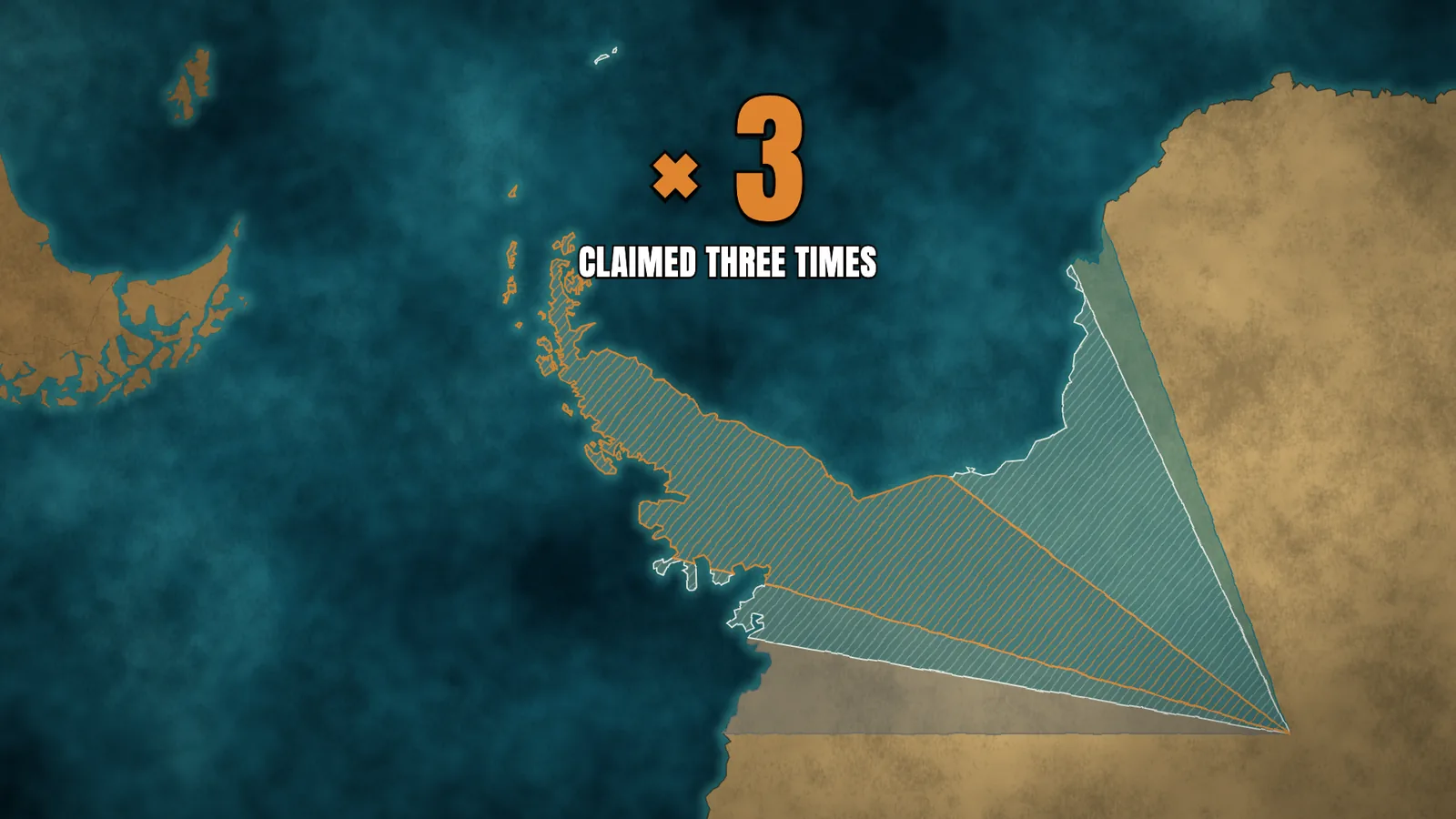
Because three claims cover it. The Argentine, British and Chilean sectors all include the stretch between 53° and 74° W: the Antarctic Peninsula and the land behind it, as far as the pole [1][2][10]. It is the part of Antarctica closest to another continent: by our calculation on Natural Earth data, the nearest South Shetland island lies about 810 km from Cape Horn [10][26].
All three claimants have been there a long time. Argentina has run its Orcadas station in the South Orkney Islands since 1904, the oldest station south of 60° S still operating [18][27]. Britain's secret wartime mission, Operation Tabarin, set up its first permanent bases in 1944, among them Port Lockroy, now a museum with a post office [17][28]. Chile's Arturo Prat base, established in 1947, is still open all year [27].
Five claimants, Australia, France, New Zealand, Norway and the United Kingdom, recognise each other's claims [1][29]. The United States and the Soviet Union recognised none and reserved a right to claim land of their own, but never made a claim [1][30]. The United States and Russia still do not recognise the claims [30][31].
In 1955 Britain took Argentina and Chile to the International Court of Justice. Neither country accepted the court's jurisdiction, and on 16 March 1956 the court removed both cases from its list [32].
Which part of Antarctica does no country claim?
Between 90° and 150° W, none of the seven claims reaches the mainland [2][10]. By our calculation on Natural Earth data, that wedge is about 12% of Antarctica [10]. Most of it is Marie Byrd Land, often called the largest unclaimed land on Earth [3]. Norway claims one small island off its coast, Peter I Island, since 1931 [2]. Britain, Japan, Norway and the United States have each made claims to parts of this sector, but "none of these has resulted in any formally defined sovereign claims" [2].
How did the Antarctic Treaty freeze the claims?
Science came first. Around 70 countries took part in the International Geophysical Year of 1957-58; twelve of them were active in Antarctica, the United States and the Soviet Union among them [33][34]. The US Navy built the first station at the South Pole in 1956 [35].
On 1 December 1959 those twelve countries, all seven claimants among them, signed the Antarctic Treaty in Washington [4][5]. It came into force on 23 June 1961 and covers everything south of 60° S, ice shelves included [4]. Antarctica is for peaceful purposes only, and nuclear explosions and radioactive waste are banned [4]. Research is free, and observers named by the deciding countries may inspect any station at any time [4][5].
The key is Article IV. Nobody had to give up a claim, and nobody had to recognise anyone else's. While the treaty is in force, "no new claim, or enlargement of an existing claim, to territorial sovereignty in Antarctica shall be asserted", and nothing done there counts for or against a claim [4].
The claims live on in national law. Argentina counts its sector as part of the province of Tierra del Fuego [21], Chile passed a new Antarctic statute in 2020 [25], Australia's is a territory of the Commonwealth [20], and the United Kingdom constituted the British Antarctic Territory in 1962 [17].
Who is in Antarctica today?
The November 2024 list of COMNAP, the council of national Antarctic programmes, counts 30 countries with stations and 42 stations open all year south of 60° S [27][36]. Inside the Australian claim alone, Russia, China, India, and France and Italy together run year-round stations [27][10]. On 7 February 2024 China opened its fifth station, Qinling, near the Ross Sea [37][38].
Some countries brought families [39][40]. On 7 January 1978 Emilio Marcos Palma was born at Argentina's Esperanza base, the first person known to have been born in Antarctica; his mother had been flown in late in her pregnancy [41][39][40]. Chile's first Antarctic birth followed on 21 November 1984, at the Eduardo Frei base [40][42]. Under Article IV, none of this can strengthen a claim [4].
A country that joins the treaty later gets a say in decisions only while it carries out "substantial scientific research activity" there, such as running a station [4][34]. When we checked on 27 November 2026, the treaty had 58 parties: 29 Consultative Parties, which take the decisions, and 29 Non-Consultative Parties, which may attend the meetings but "do not participate in the decision-making" [34]. Decisions are adopted by all Consultative Parties present [43].
Does the Antarctic Treaty expire in 2048?
No. The 1959 treaty does not mention mining [4]. A 1988 convention that would have allowed carefully regulated mining never came into force: Australia would not sign, and France joined Australia [7][44]. In 1991, in Madrid, the parties signed a Protocol on Environmental Protection that designates Antarctica "a natural reserve, devoted to peace and science" [45][7]. Its Article 7 reads in full: "Any activity relating to mineral resources, other than scientific research, shall be prohibited." [45] The Protocol came into force on 14 January 1998 [7].
The date 2048 comes from Article 25. From 14 January 2048, 50 years after entry into force, any Consultative Party may ask for a conference to review the Protocol [45]. That is a meeting, not a deadline. Even then, the mining ban continues unless a binding legal regime for mineral activities is in force [45]. Any change adopted there also needs ratification by three-quarters of the Consultative Parties, including all 26 that were Consultative Parties in 1991 [45][34].
One more detail, left out of the video for time: if a change to the mining ban adopted at a review conference has not come into force within three years, any party may give notice that it is leaving the Protocol, and the withdrawal takes effect two years after the notice reaches the depositary [45].
The treaty itself has no end date [4]. In 2023 the Consultative Meeting noted that "many hold the mistaken belief that the Protocol expires in 2048" and asked governments to commit to "dispelling the myth that the Antarctic Treaty or the Protocol expire, either in 2048 or at any other time" [6].
What the video left out
- Ecuador's declaration. In 1967 Ecuador declared a narrow Antarctic sector of its own, overlapping part of Chile's claim; in 1987 it acceded to the treaty and became bound by Article IV [2].
- An earlier review date. The treaty's Article XII allowed a review conference after 30 years, from 1991, if a deciding country asked for one: a review, not an end date [4].
Corrections
No corrections as of 27 November 2026. Found an error? Send the paragraph and your source through our corrections page; confirmed fixes are listed here with their date.
Sources
- Did you know that seven countries have claims in Antarctica?. Norwegian Polar Institute (Sørpolen 2011) (official).
- Territorial claims in the Antarctic Treaty region (information sheet). R. K. Headland, Scott Polar Research Institute, University of Cambridge (12 Apr 2022) (academic).
- Can any country claim Antarctica? Unpacking the Antarctic Treaty. Geographical (V. Heath, 7 Jan 2025) (secondary).
- Antarctic Treaty: text and narrative (Bureau of Arms Control archive). U.S. Department of State (depositary government), 2009-2017 archive (official).
- The Antarctic Treaty. Secretariat of the Antarctic Treaty (official).
- Resolution 3 (2023), ATCM XLV - CEP XXV, Helsinki: reaffirming commitment to the prohibition on mineral resource activities. Secretariat of the Antarctic Treaty (official).
- Protocol on Environmental Protection to the Antarctic Treaty (The Madrid Protocol). Australian Antarctic Division (page updated 17 May 2019) (official).
- Mercator (projection reference). Esri, ArcMap documentation (reference).
- How are different map projections used?. US Geological Survey (FAQ) (official).
- Natural Earth 1:10m land, Antarctic ice shelves, Antarctic claims and claim limit lines (v5.1.2); world-atlas countries; computed in geo/make_specs.py. Natural Earth (public domain), computed by Causeway Atlas (primary, data, derived).
- Africa (continent). Encyclopaedia Britannica (reference).
- Australian Antarctic Territory (dimensions). Geoscience Australia (updated 30 Nov 2022) (official).
- Area of Australia - States and Territories. Geoscience Australia (official).
- An automated methodology for differentiating rock from snow, clouds and sea in Antarctica from Landsat 8 imagery (The Cryosphere 10, 1665-1677). A. Burton-Johnson, M. Black, P. T. Fretwell, J. Kaluza-Gilbert (2016) (academic).
- Human impact (Polar Discovery). Woods Hole Oceanographic Institution (academic).
- Antarctica (Research Starters). EBSCO (E. Badertscher, 2023) (reference).
- History of the Territory. Government of the British Antarctic Territory (page modified 15 Jun 2022) (official).
- Legal Analysis of the Argentine and Australian Titles to Territory in Antarctica (Melbourne Journal of International Law 23). B. Arpi, J. McGee, A. Jackson, I. Hodgson-Johnston (2022) (academic).
- New Zealand claims Ross Dependency (16 August 1923). NZHistory, Ministry for Culture and Heritage (New Zealand) (official).
- The Australian Antarctic Territory (AAT). Australian Antarctic Division (updated 15 Apr 2016) (official).
- Sector Antártico Argentino. Ministerio de Relaciones Exteriores (Cancillería), Dirección Nacional del Antártico, Argentina (official, in Spanish).
- Norway's path to the Antarctic Treaty (Fram Forum 2021). Fram Centre, Fram Forum (H. D. Jølle, polar historian, Norwegian Polar Institute; 18 Jan 2021) (secondary, historian, research-centre magazine).
- Neuschwabenland. W. A. Boelcke, Schwäbische Heimat (c. 1979/80), WLB Stuttgart journal archive (academic, in German).
- Abstract, Antarctic session, PCRC symposium (Kobe University) 2019. J. R. Thompson, Kobe University Polar Cooperation Research Centre (academic).
- Ley 21.255, Estatuto Chileno Antártico (copy on CEPAL Geo; promulgated 21 Aug 2020, published 17 Sep 2020). Republic of Chile (law text) (official, in Spanish).
- Drake Passage. Encyclopaedia Britannica (reference).
- COMNAP Antarctic Facilities list, November 2024 (CSV). COMNAP (data).
- Port Lockroy. UK Antarctic Heritage Trust (official).
- International recognition of the Australian Antarctic Territory 'irrelevant' to legal claim. UNSW Sydney Newsroom (29 Jun 2021), on S. V. Scott, The Irrelevance of Non-Recognition to Australia's Antarctic Territory Title (secondary, university news, on a peer-reviewed paper).
- Antarctica and US policy: a strategic evolution amid global shifts (Antarctic Science 37(5): 501-510). A. Szpak (2025) (academic).
- Note No. 1682 on Norway's CLCS submission. Permanent Mission of the Russian Federation to the United Nations (15 Jun 2009) (official).
- Antarctica (United Kingdom v. Argentina): overview of the case. International Court of Justice (official).
- What was the International Geophysical Year?. UK Antarctic Heritage Trust (2023; page dated 16 Jul 2026) (secondary).
- Parties. Secretariat of the Antarctic Treaty (official).
- How human presence at South Pole has evolved over the past century. U.S. National Science Foundation (1 Dec 2022, updated 9 Mar 2026) (official).
- Antarctic Facilities Information. COMNAP (Council of Managers of National Antarctic Programs) (official).
- China opens fifth research station in Antarctica (PTI). The Week (Press Trust of India wire, 7 Feb 2024) (news).
- China opens fifth Antarctic research station. China Daily HK (Zhao Lei, 7 Feb 2024) (news).
- Base Esperanza. Cancillería Argentina, Dirección Nacional del Antártico (official, in Spanish).
- Born in Antarctica: The White Continent Has 11 ‘Citizens’. ExplorersWeb (A. Routen, 30 Sep 2025) (news).
- First person born in Antarctica (Most southerly birth). Guinness World Records (reference).
- Chile en la Antártica: a treinta años del primer chileno nacido en el fin del mundo. 24horas.cl (TVN), C. Bravo, 25 Nov 2014 (news, in Spanish).
- Rules of Procedure of the Antarctic Treaty Consultative Meeting and the Committee for Environmental Protection (updated October 2024). Secretariat of the Antarctic Treaty (official).
- Twenty five years of the Protocol on Antarctic environmental protection (Australian Antarctic Magazine 31). Australian Antarctic Division (P. Tracey, 12 Dec 2016) (official).
- Protocol on Environmental Protection to the Antarctic Treaty (Compilation of Key Documents, vol. 1). Secretariat of the Antarctic Treaty (official).
Watch the video

The player loads from YouTube only after you press play. See our privacy policy.
Chapters
- 0:00Intro
- 0:41The Edge of the Map
- 1:49Slicing the Pie
- 3:11One Peninsula, Three Claims
- 4:44Putting It on Ice
- 6:57Life on the Ice
- 8:19What Happens in 2048?
- 9:51Back to the Map